Bridging the Reality Gap
Why Dose of Reality exists


Thanks for subscribing to the new Dose of Reality Newsletter. For our first regular post, we wanted to tell you why we are building Dose of Reality and what it’s here to achieve.
Before we go into it, a quick question. If you watched the football last night (my daughter kindly unintentionally woke me up at 3:30am, and I’ve never been more grateful) - where did Thomas Tuchel watch the game from? Row Z, where he can see the tactics play-out perfectly? Or the dugout. Close to the action? We’ll come back to this…

Throughout our careers, we have spent lots of time in meetings where brands would talk about customer centricity, but when you scratch the surface, you realise few are actually close to their customers.
Their organisational structure, where their budgets go, a lack of context, constant re-orgs and sometimes laziness all lead to that vision of customer centricity not really being true.
More access to other people’s lives doesn’t automatically mean ‘more understanding’.
That is the tension at the heart of Reality AdvantageTM.
We’re divided
We live in a time where people are more ‘connected’ than ever, but often feel further apart. This oxymoron is apparent time and time again in our conversations with participants.
The ability to connect instantly means expectations of instant responses rise too. It means we have no excuse not to reply, or to engage, other than ‘it was less of a priority’. But worst of all, it means cliques can form quicker than ever, often defined more by differences between ‘us’ and ‘them’, than by commonalities within the group. It’s easier than ever to find differences between us all in the vast volumes of information we have access to; but often harder to clearly articulate what we all have in common.
This applies to businesses as much as the general population. The same distance we see in society is often mirrored inside brands, agencies and boardrooms.
We have more information than we’ve ever had before. But the data is shallow. And lots of shallow data gives the illusion of customer proximity. We can say we have ‘65,000 signals’ about every one of our customers, but every signal was not created equally.
This isn’t helped by the current short-termism rife across society. There’s more pressure to move faster, spend less, produce more and make decisions with confidence. But in reality, less time is spent with the people those decisions are supposed to serve.
That is the Reality Gap: the gap between how people really live, think, feel and behave, and how businesses imagine them from a distance.
The comfort of distance
Back to England vs Mexico. Partly just to revel.
There’s an argument to be made that it’s easier to see what’s happening on a football pitch from a birds-eye view, far away from the action, than it is on the front row. You can get the ‘whole picture’.
This distance is seductive.
It feels efficient.
It feels controlled.
It feels professional.
It gives us clear patterns, summaries, and ‘neatness’.
We can sound smart and draw conclusions not based on small sample sizes, but based on the ‘bigger picture’, statistical significance and all.
But the best managers, football or otherwise, sit in the dugout. You’ll probably say ‘yes, but they have screens and data to show summary stats of the game’. And you’d be right - we need data too!
But it’s better to be close to the action, where you can hear and ask which players are struggling the most with the thin air 7,000 ft above sea level, than far away, where you have to guess based on ‘signals’.
And now, with AI, distance is easier and more appealing than ever.
We can create synthetic audiences.
We can generate synthetic respondents.
We can ask synthetic personas what they think.
We can receive confident, plausible answers in seconds.
All of it neatly packaged up, conveniently tidy and not contradictory. Delivering clean, efficient, tidy fake realities to their end users. And there’s no doubt that sanitised - easier to swallow - realities may be useful to some businesses.
But it also makes the industry’s distance problem worse.
Because the more comfortable this simulation of people becomes, the easier it is to stop looking for true reality.
People are not clean
Real people are rarely as clean, simple, uncomplicated and easily segmented as the research outputs we create about them.
They contradict themselves.
They change their minds.
They say one thing and do another.
They care deeply about things brands never ask about.
They ignore things brands spend months obsessing over.
They are shaped by money, family, work, class, place, health, pride, shame, boredom, humour, habit, exhaustion and hope.
Only by getting close to the action. By sitting in the dugout. Can you get close to understanding the contradictions that make us who we are, and by making the best decisions.
That complexity is not a problem, it is a function of the system. A function of being human. It is very the material we should be trying to understand.
Reality AdvantageTM
Reality AdvantageTM is the belief that brands make better decisions when they are closer to real life.
Not just closer to data.
But closer to the action.
Closer to people.
Closer to language.
Closer to homes.
Closer to context.
Closer to the gap between what people say and what they do.
Closer to the emotional and practical reality of how decisions actually happen.
It is not an argument against quantitative research.
It is not an argument against data.
It is not an argument against AI.
Tuchel still needs the screens with the tactics and the stats.
It is an argument against using those things as substitutes for real human understanding.
Because, used well, data can show us scale.
And AI can help us search, organise and retrieve material faster.
Quant can help us understand how widespread something might be.
But none of those things should become an excuse to remove real people from the process.
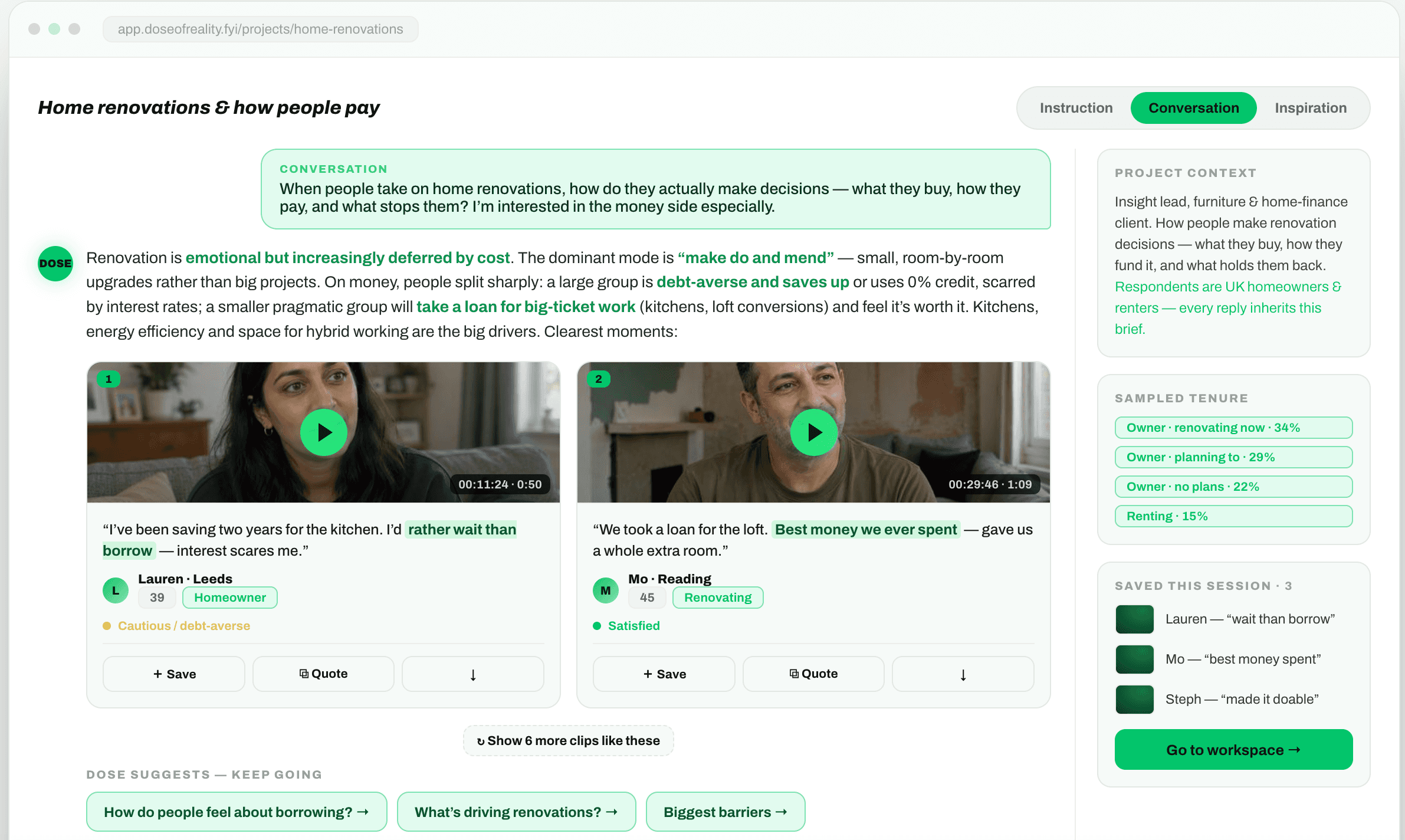
That is where Dose of Reality sits. In the dugout.